What Is the Most Secure eSIM for International Travel?
Security Isn't a Feature. It's a Foundation.
When you connect to a cellular network abroad, you're trusting a chain of infrastructure you didn't choose: the local tower, the carrier your eSIM partners with, and the provisioning systems behind your eSIM profile. Most travelers don't think about any of this — until something goes wrong.
The good news is that eSIMs are inherently more secure than physical SIM cards in several meaningful ways. The important nuance is that how secure your connection is depends heavily on which provider you choose and how you configure your device.
Why eSIMs Are Already More Secure Than Physical SIMs
The security advantage starts at the hardware level. Because an eSIM is embedded directly in your device's chip and can't be physically removed, it eliminates a whole category of risk — SIM swapping attacks where a thief pops out your physical card and drops it into another device.
Remote provisioning — the process of downloading your eSIM profile over the air — relies on robust cryptographic protocols that ensure only you and your carrier can activate and manage the profile. These protocols significantly reduce the risk of interception during activation.
If your phone is stolen, you can disable your eSIM remotely, making it much harder for someone to exploit your number or identity. With a physical SIM, the attacker already has the card in hand.
The Part the Marketing Doesn't Always Tell You
eSIM security is only as strong as the carrier behind it. Many providers rely on legacy telecom infrastructure with outdated trust-based architectures, which means certain network-level threats — SS7 protocol attacks, suspicious signaling requests, IMSI tracking — are still possible regardless of which eSIM app you're using.
The provisioning layer is secure. The network layer varies.
This is why provider choice matters beyond coverage and price.
What to Look for in a Secure Travel eSIM
Web protection and ad blocking — Some providers, particularly those built by cybersecurity companies, include built-in ad and tracker blocking. This isn't just a privacy perk: it also reduces your data consumption by filtering out tracking scripts before they load.
Virtual location — A handful of providers offer a virtual location feature that routes your traffic through a different geographic node, functioning similarly to a VPN. This is especially useful in countries with restricted internet access or aggressive network monitoring. One important caveat: this protection applies only when you're using the eSIM's cellular data, not when you're on public Wi-Fi.
Minimal data collection — Look at what information the provider requires to sign up. Privacy-first carriers operate on a minimal-trust model where you provide as little personal data as possible, limiting your exposure if the provider's systems are ever compromised.
Proprietary network infrastructure — Some security-focused carriers operate their own mobile core rather than relying entirely on third-party wholesale networks. This reduces the number of parties that can access your traffic and provides more control over network-level threats.
The Public Wi-Fi Problem
Using cellular data from a trusted eSIM is one thing. Connecting to the airport lounge Wi-Fi, the hotel network, or a café hotspot is something else entirely. Your eSIM does not protect you on public Wi-Fi — the two are completely separate.
If you're accessing banking, corporate email, or sensitive documents while traveling, always use a VPN on public networks regardless of which eSIM you have. Some eSIM providers bundle VPN access into their premium plans; others require a separate subscription.
A Practical Security Checklist for Travelers
Before your trip, run through these steps:
- Enable device encryption if it isn't already on
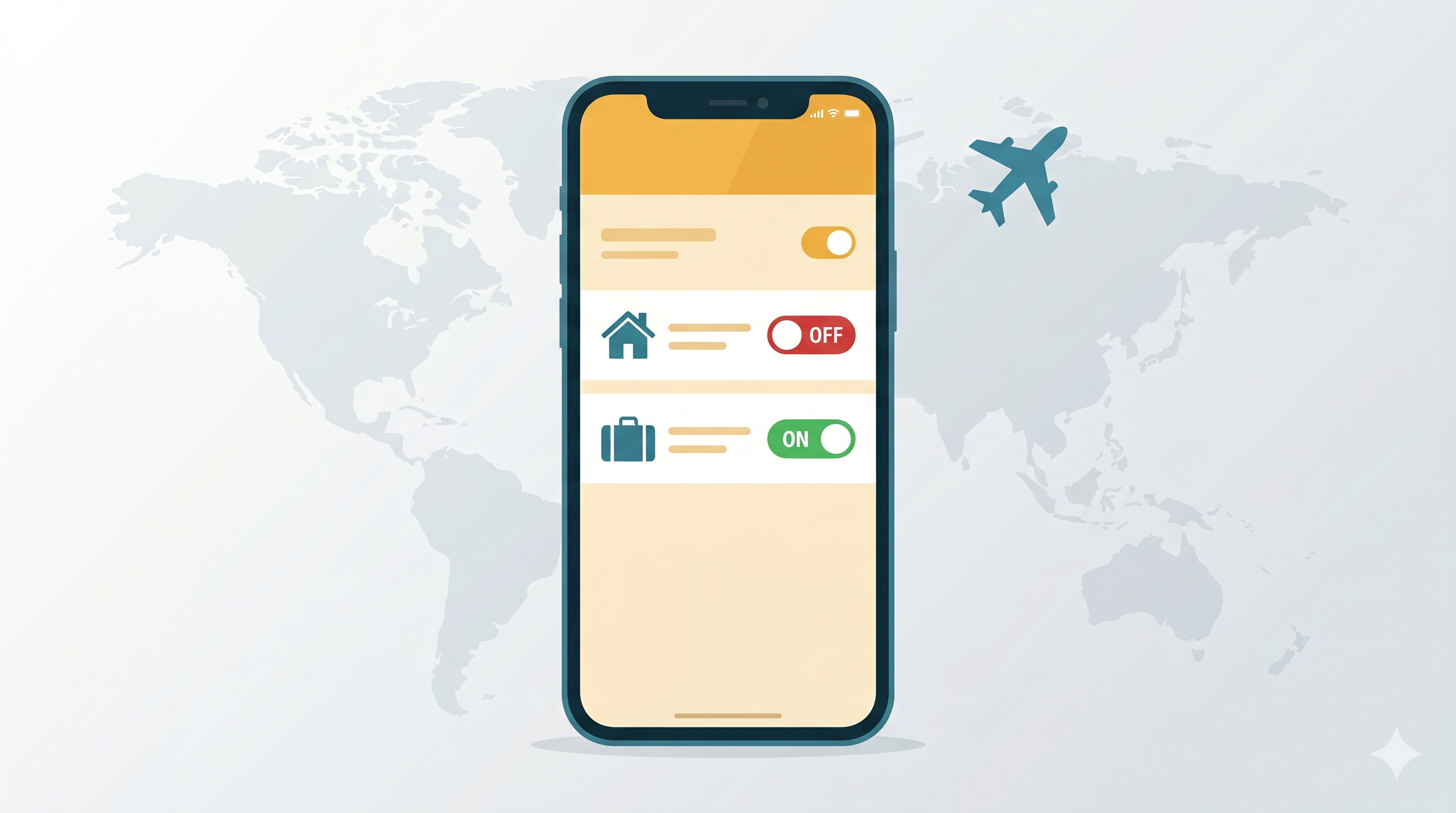
- Turn off data roaming on your home SIM (more on this in our setup guide) so background apps can't quietly use your primary carrier's network
- Set a strong screen lock — if your device is lost, the eSIM is only as secure as the phone protecting it
- Use two-factor authentication methods that don't depend solely on SMS, especially for banking apps, since you'll be operating on a different number than your home SIM
- Avoid sensitive transactions on public Wi-Fi; use your eSIM's cellular data or a VPN instead
For Business Teams: Security at Scale
Individual travelers can manage most of this manually. Businesses face a harder problem: ensuring that every employee's device is configured correctly, that eSIM plans can be revoked if a device is lost, and that data usage is monitored without invasive device management.
SYLA Business addresses this at the platform level. Centralized plan management means you can assign, monitor, and revoke eSIM access from a single dashboard — no chasing down devices, no waiting for a physical card to be mailed back.
If your team travels internationally and handles sensitive data on the road, talk to us about how SYLA manages security at scale.
Start managing eSIMs smarter
See how SYLA Business gives your team global connectivity in 190+ countries from one dashboard.
Book a Demo